I don't know about you but I had always problems with tenses of English verbs, maybe because I've learned English by myself rather than in school. Anyway, English grammar is not impossible to learn if you find a pattern that is easy to follow and remember. Below I have compiled a table of English tenses.
In English we have only three main tenses along the time axis:
past
present
future
Each of these main tenses is divided in four other subdivisions:
simple
continuous
perfect
perfect continuous
The resulted English tenses is just a Cartesian product of these two sets:
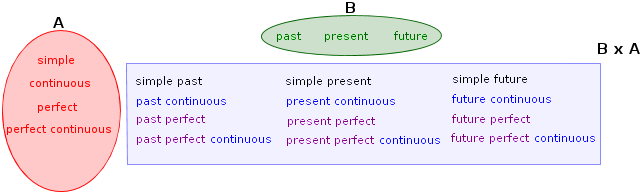
When to use what? - that's somewhat obvious:
past for events started and finished in the past or that are no longer true at the moment of speaking
present for events that happen at the moment of speaking or that are scheduled to happen in the near future
future for events that will happen in the future
How are these tenses constructed? Can we find and use a pattern? Yes, we can:
Past | Present | Future | |
Simple | verb+ed  | verb+s/es* | will+verb |
Continuous | was/were+verb-ptp | am/is/are+verb-pp | will+be+verb |
Perfect | had+verb-ptp | has/have+verb-ptp | will+have+verb-ptp |
Perfect continuous | had+been+verb-pp | has/have+been+verb-pp | will+have+been+verb-pp |
where:
verb is the verb at infinitive form
verb-ptp is the past participle of the verb
verb-pp is the present participle of the verb
* applies only when used in third person
In addition to the above links
, one good online resource that I treasure a lot is Seonaid's website called "Perfect English Grammar". Seonaid is a British native speaker of English. She has a Master's degree (M Phil) from Cambridge University in English and Linguistics.
Have fun!
Comments
No comments yet
Be the first to leave a comment.
Leave a comment